

Valentina Akpan: Founder of Rellatech, providing administrative and operations support to executives, founders, business owners and teams. Her background combines technical support, customer success, administration and operations.
·
The business had fourteen months of weekly coaching clinics stored in Otter.ai. The calls were transcribed, but each one was saved separately, which made the material hard to use. The client asked me to bring them into one place, ordered newest to oldest, so the team could search, reference and reuse them.
Below, I explain what the finished system looks like, share the numbers from the documented run, and describe why finding the material again mattered to the business.
The Outcome
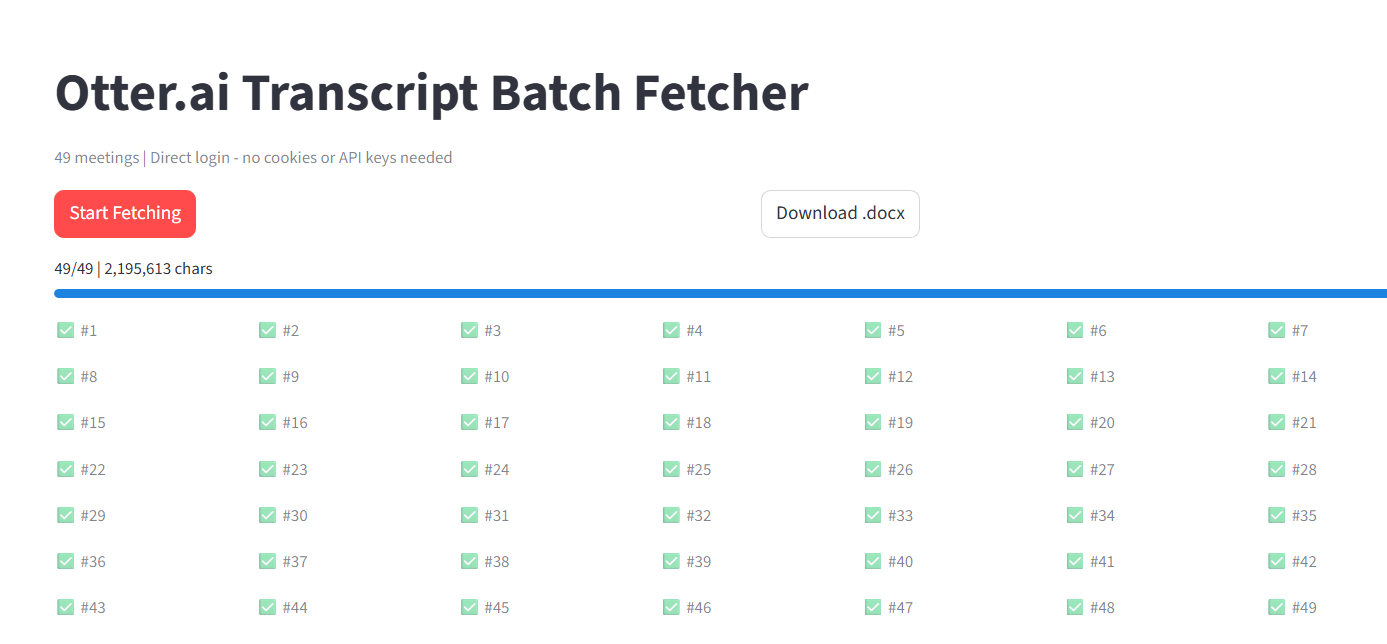
I delivered a single Word document, ordered newest to oldest, with every coaching session in clean, readable form. Building the tool and running it for the first time took under two hours of my time in total. The run itself, from login to delivered file, took around ten minutes and did not need anyone watching it. There was no copying and pasting, no manual exporting and no cleanup afterwards. The figures below are from the documented run shown in the screenshot further down.
49
Transcripts compiled
2.19M
Characters captured
10 min
Unattended runtime
< 2 hrs
Build and first run
Why It Mattered
Each clinic call included decisions, frameworks and client progress. Saved one by one in Otter.ai, that material was hard to find again. Looking through 49 separate recordings for a particular quote, explanation or piece of advice was not practical for the team.
In a single document, the same content becomes a reference the business can use. The team can search it in seconds and quote it in emails, proposals and content. It is also easy to share with a team member, an editor or a future ghostwriter.
The content was useful already. Saved one recording at a time, it was simply hard to search.
What Got Built
I built a small Streamlit app that runs on the owner's desktop. The owner enters their Otter.ai login, the app fetches every transcript in order, and it saves a formatted Word document to the desktop. Those are the only steps the owner needs to take.
The app uses Python with the open-source otterai-py library and python-docx. The business now owns the tool and can run again at any time with its own Otter.ai login, with no manual export steps and no extra subscription attached.
What This Means for Other Businesses
I see the same situation in many businesses that rely on what they know. A lot of useful material is stored in the tools you already pay for, such as recordings, customer notes, support emails and sales calls. Most of those tools were not designed to help you find that material again.
With a clean extraction, the right format and a small piece of automation, the business can search and reuse that content. I enjoy this kind of work, and I am glad to look at what you have stored.
Need help with similar work?
Tell me which responsibilities or processes need attention, who is involved and any upcoming deadlines. I provide administrative and operations support, including the connected technical work within our agreed scope.
Book a free call